
Insights · September 3, 2025
Yieldstreet, Crowdfunding, and the Problem With Chasing Flashy Real Estate Returns

What’s Going Wrong in Real Estate?
Recently, CNBC highlighted a troubling trend: many Yieldstreet investors are facing losses of 50% or more on real estate deals that once looked enticing. On paper, the returns seemed compelling. In practice, many of these projects were speculative, opaque, and poorly underwritten.
The root cause? Yieldstreet is primarily a marketplace, a platform that connects investors to outside sponsors raising capital for their own projects. Most of these are equity-focused real estate development deals, where execution risk lies with the project sponsor or general partner, not Yieldstreet itself.
In these structures, returns depend on appreciation, leasing success, or construction execution. And in real estate, when deals go south, equity investors are last in line. In many of these cases, they lost most or all of their capital.
Debt vs. Equity: Why Capital Structure Matters
At Finresi, we take a different approach. We’re not an equity platform.
Instead, we focus exclusively on real estate debt, specifically first-lien bridge and fix & flip loans secured by U.S. residential properties. That means our investors’ capital is protected by:
- Conservative loan-to-value ratios (30–70%)
- Tangible real estate as collateral
- Short-term, fully underwritten loans
- Direct lien positions
- Monthly interest payments from borrowers
We don’t bet on appreciation. We invest in underwriting, control, and asset security.
We’re Not Crowdfunding. We’re Investing.
Another key distinction: Finresi is not a crowdfunding platform.
Crowdfunding platforms must raise investor money before closing a deal. If the raise falls short, the deal may collapse, or worse, the platform may push through deals that shouldn’t be funded.
Finresi operates differently. We pre-fund every deal with our own capital before investors ever see it. That means:
- The deal is already vetted, closed, and committed before you invest.
- We put our own money at risk first.
- There’s no “race to fill the raise,” no gimmicks, no uncertainty.
We lead. You invest alongside us.
How Finresi Compares
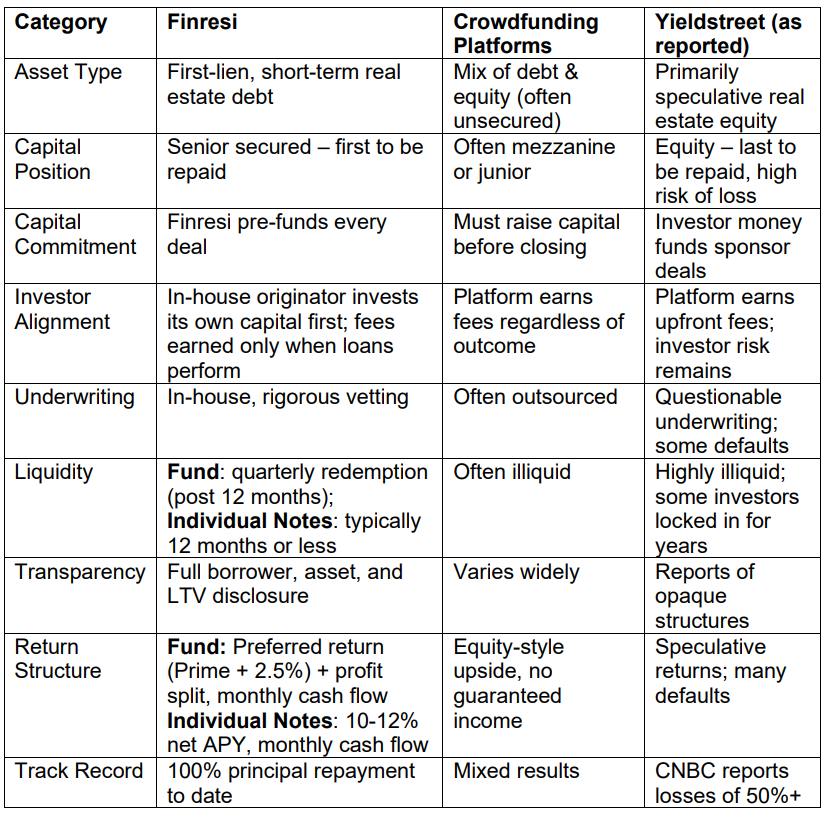
A More Disciplined Path to Yield
As platforms and investment firms collapse under the weight of underperformance and broken promises, Finresi is doing what we’ve always done:
- Prioritize risk-first underwriting
- Maintain downside protection through first liens
- Avoid unrealistic promises
- Offer institutional-quality access to residential real estate debt
Our new Finresi Fund I is built for accredited investors who want yield, with structure, transparency, and true alignment.
The Bottom Line
Chasing flashy projected returns may feel exciting, but as many Yieldstreet investors have learned, it often ends in painful losses.
Real estate doesn’t reward hype, speed, or marketing. It rewards diligence, discipline, and downside protection.
That’s what Finresi delivers.
Learn more at www.finresi.com or email info@finresi.com
Disclaimer: This material is provided for informational purposes only and does not constitute an offer to sell, or a solicitation of an offer to buy, any securities. Any securities described herein will only be offered to accredited investors pursuant to formal offering documents, which contain important information concerning investment objectives, risks, charges, and expenses. Past performance is not indicative of future results, and there can be no assurance that any investment will achieve its objectives or avoid substantial losses. Investments in private real estate debt carry risk, including potential loss of principal. Investors should consult with their financial, tax, and legal advisors before making any investment decision.
Keep reading
 Insights
The Finresi Fund: A Deep Dive into Diversified Real Estate Debt Investing in 2026
The Finresi Fund is a pooled real estate debt vehicle giving accredited investors diversified exposure to private loans, including fix-and-flip, bridge, and construction financing. It offers passive income through interest distributions while spreading default risk across an entire loan portfolio.
 Insights
A Look Inside a Live Deal: Anatomy of a Fix-and-Flip Loan Investment
Fix-and-flip loan investments give accredited investors a first lien position on short-term real estate debt, typically yielding 8–12% annually. Walk through a live deal to see exactly how capital is deployed, protected, and returned.
